
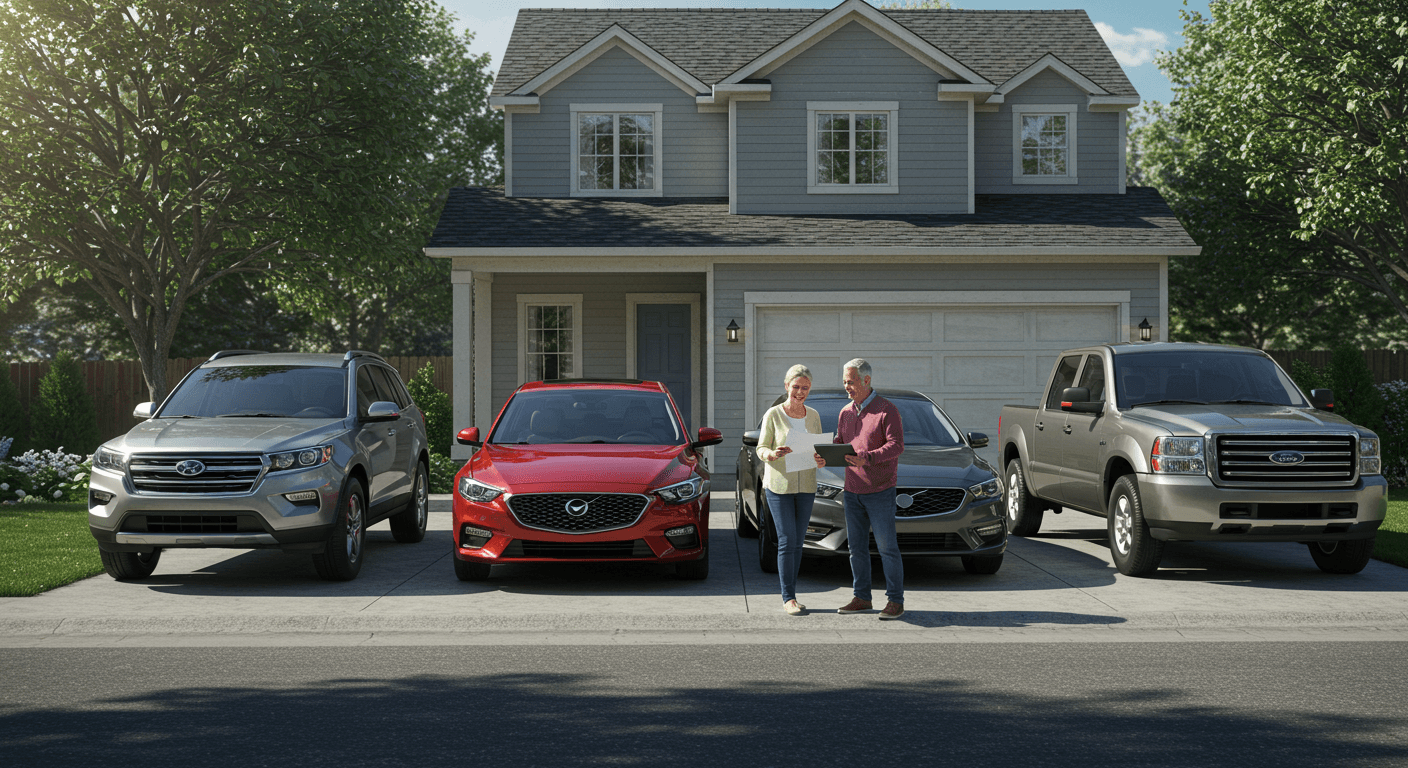
If your driveway looks more like a dealership lot — with two, three, or maybe even four vehicles parked bumper-to-bumper — you’re not alone. Families today are juggling multiple schedules, work commutes, and weekend errands. And when each family member needs a set of wheels, car insurance costs can skyrocket fast.
Here’s the good news: bundling all those vehicles under one insurance policy could save you hundreds — even over $1,000 a year. It’s called multi-car insurance, and it’s one of the simplest ways to cut your premium without sacrificing coverage.

In this guide, we’ll break down everything you need to know about multi-car insurance in 2025 — including which companies offer the cheapest rates, where to find the biggest discounts, and how to maximize your savings.
Let’s dive in.
What Is Multi-Car Insurance?
Multi-car insurance is exactly what it sounds like: a single auto insurance policy that covers two or more vehicles parked at the same household (and usually owned by related drivers).
Instead of juggling multiple policies with different due dates, insurers let you combine everything into one — and reward you with a multi-car discount, typically ranging from 10% to 25%.
Real-Life Example:
When my neighbor Lisa added her college-aged daughter’s car to her existing policy, her insurer applied a 22% multi-car discount. That single move saved them $624 per year, even though the second vehicle (a 10-year-old sedan) wasn’t worth much on paper.
Why? Because insurance companies want your business — and rewarding you for keeping it “all in the family” is a win-win.
How Much Can You Save With Multi-Car Insurance in 2025?
According to a 2025 report from The Zebra, the average multi-car insurance policy in the U.S. costs about $1,855 per year, compared to $1,258 for a single car. But if you were to insure two cars separately, you’d likely be paying well over $2,200 annually.
That means multi-car discounts can shave off $300–$700 per year, depending on your vehicles, location, and driving history.
| Household Size | Estimated Annual Savings |
|---|---|
| 2 vehicles | $250–$600 |
| 3 vehicles | $500–$950 |
| 4+ vehicles | $800–$1,200+ |
Tip: Even older vehicles benefit from bundling. Don’t assume that an older car doesn’t need insurance — or that it’s better off on a separate policy.
Cheapest Multi-Car Insurance Companies in 2025
We compared average multi-car insurance rates from top U.S. insurers. Here’s how they stack up:
| Insurance Company | Average Multi-Car Rate | Multi-Car Discount Range |
|---|---|---|
| GEICO | $1,720/year | 15%–25% |
| State Farm | $1,775/year | Up to 20% |
| Progressive | $1,840/year | Up to 12% |
| Allstate | $1,915/year | 10%–25% |
| Nationwide | $1,965/year | Around 20% |
| USAA (for military) | $1,650/year | Up to 25% |
Note: Actual rates will vary based on location, vehicle type, and driver history. Always compare quotes for the most accurate pricing.
Who Qualifies for Multi-Car Insurance?
To qualify, you typically need:
At least two vehicles registered at the same address
Drivers who are related by family or marriage (though some companies allow roommates or domestic partners)
Vehicles used for personal, not commercial, use
If your teen drives a car to school, or your spouse uses one for their daily commute — both can be included under the same policy.
Mark’s Take: I often get asked if two unrelated roommates can share a policy. Some insurers allow it, but you’ll need to shop around. Always be upfront with your insurer about your living and driving arrangements.
How Multi-Car Discounts Work
Insurers apply a percentage discount to each vehicle added to your policy beyond the first. But here’s what many people don’t realize:
Your discount applies to each vehicle, not just the total policy.
All cars don’t need the same coverage levels (e.g., one might only carry liability, another full coverage).
Some insurers even combine multi-car and multi-policy discounts (like bundling home + auto).
That’s where the real savings stack up.
When Multi-Car Insurance Doesn’t Make Sense
While multi-car insurance is almost always cheaper, there are a few exceptions:
Different addresses: If your adult child lives out of state with their own car, they’ll likely need a separate policy.
Risky drivers: Adding someone with multiple violations or accidents could raise your rate more than the discount saves you.
Commercial use vehicles: Work vans or rideshare vehicles (Uber/Lyft) may require separate commercial coverage.
If any of these apply to you, it’s still worth comparing both bundled and unbundled quotes.
How to Find the Best Multi-Car Insurance Policy
Here’s how to make sure you’re getting the most bang for your buck:
1. Get at Least Three Quotes
Start with major carriers like GEICO, Progressive, and State Farm — but don’t overlook regional insurers either.
2. Ask About Stacking Discounts
Look for companies that allow you to combine multi-car with safe driver, loyalty, or pay-in-full discounts.
3. Compare Apples to Apples
Make sure each quote includes the same deductibles, limits, and coverage types so you’re not misled by a lower price with less protection.
4. Review Coverage Annually
If your teen moves away or trades in their car, your policy needs will shift — and so should your strategy.
Real Story: How the Thompsons Saved $970 a Year
The Thompsons — a family of five in Ohio — had three separate car insurance policies through different companies. When their 18-year-old daughter got her own used car, they decided to consolidate everything into a single multi-car policy through Nationwide.
After adding all three vehicles and combining their homeowner’s policy, their agent applied:
A 20% multi-car discount
A 10% loyalty discount
A 5% bundling discount
Their new total premium dropped by $970 per year. That’s nearly a thousand bucks back in their pocket — all from one phone call.
FAQs About Multi-Car Insurance
Can I insure two cars at different addresses?
Usually no. Most insurers require all vehicles to be garaged at the same address. There are exceptions for college students or military members — so ask your insurer.
Will my rate go up if I add a teen driver?
Possibly — teens are riskier to insure. But bundling them under a multi-car policy often costs less than giving them a standalone policy.
Can I have different coverage for each car?
Yes. You can choose liability-only for an old car and full coverage for a newer vehicle under the same policy.
The Bottom Line: Is Multi-Car Insurance Worth It?
Absolutely — if you’re insuring more than one vehicle, multi-car insurance is one of the easiest ways to cut costs without cutting corners.
From bundling discounts to streamlined billing, it simplifies your life and your budget.
Just remember: not all insurers offer the same deals, and your savings depend on your household’s unique driving profile. The only way to know for sure? Compare quotes, ask questions, and review your policy regularly.
One Last Thought from Budget Insurance Agency
At Budget Insurance Agency, we believe saving money on car insurance shouldn’t mean sacrificing quality coverage. Whether you’re a family of five or a couple with his-and-hers sedans, our licensed agents can help you find the right multi-car policy at the best possible price.
Let us help you unlock the savings you deserve — start your free quote today and see how easy it is to keep your cars (and your wallet) protected.
Add a Comment